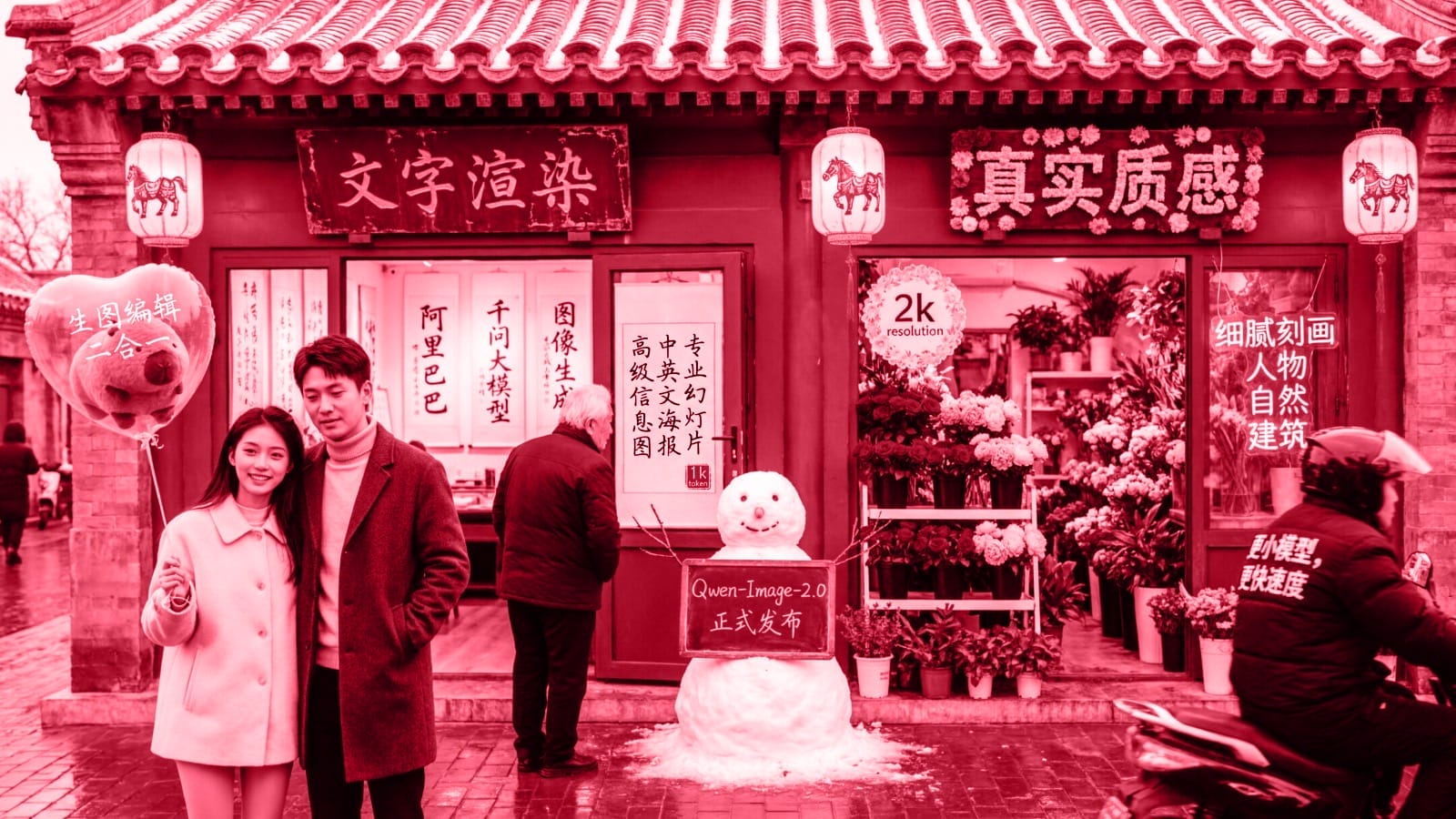
Alibaba’s Qwen research team has released Qwen-Image-2.0, a foundational image generation model that merges text rendering, photorealism, and editing capabilities into a single system. The model supports native 2K resolution and processes instructions up to 1,000 tokens in length.
The Qwen Team reports in the official Qwen Blog that the model can directly generate professional materials including presentation slides, posters, and infographics. Blind testing on AI Arena shows Qwen-Image-2.0 achieves superior performance on both text-to-image and image-to-image benchmarks using the same model architecture.
The model marks a consolidation of two previously separate development tracks. Qwen’s generation track focused on accuracy and realism, with releases emphasizing text rendering in August and photorealism in December 2025. The editing track explored single-image editing, multi-image editing, and consistency improvements throughout 2025. Qwen-Image-2.0 now delivers both capabilities simultaneously.
The model demonstrates five core strengths in text rendering. Precision allows accurate rendering of complex typography and development timelines. Complexity enables handling of instructions up to 1,000 tokens, supporting intricate designs like business reports with statistical analysis sections. Aesthetic quality manifests in natural text layout within images, including traditional Chinese calligraphy styles like Emperor Huizong’s Slender Gold script. Realism permits text rendering across different materials and spatial orientations with accurate lighting and reflections. Alignment ensures proper text organization in structured formats like calendars and comic panels.
Beyond text rendering, Qwen-Image-2.0 shows improvements in photorealistic image generation. The model can render complex scenes with detailed textures, including muscle definition, fabric weave, and environmental elements. One demonstration generates a forest scene using over 23 distinct shades of green with different material properties.
The unified architecture allows generation capabilities to transfer directly to editing tasks. Users can add calligraphy to existing photographs or combine elements from multiple images into cohesive compositions. The model maintains visual consistency when editing images while preserving photorealistic qualities.
The system benefits from integration with large language models. Users can provide simple prompts that are expanded into detailed descriptions using world knowledge embedded in LLMs. A basic request for a travel poster can be rewritten into a comprehensive prompt specifying composition, style, and content details.
Qwen-Image-2.0 is available through the Qwen platform. The development represents a shift from specialized models for generation and editing toward unified systems that handle multiple tasks with a single architecture.

