
OpenAI has begun testing advertisements in ChatGPT for users in the United States. The company displays ads to adult users on the free and Go subscription tiers, while Plus, Pro, Business, Enterprise, and Education subscribers will not see them.
According to OpenAI, ads do not influence the answers ChatGPT provides. The company states that it keeps conversations private from advertisers. Ads appear clearly labeled as sponsored content and visually separated from ChatGPT’s responses.
The timing of the launch is notable. OpenAI introduced ads just hours after competitor Anthropic aired Super Bowl commercials criticizing the practice. Anthropic’s ads showed chatbots giving biased recommendations disguised as advice, ending with the tagline “Ads are coming to AI. But not to Claude.”
OpenAI CEO Sam Altman called Anthropic’s commercials “funny” but “clearly dishonest” on Twitter. He stated that OpenAI would never run ads in the way Anthropic depicted.
How the ads work
OpenAI matches ads to users based on conversation topics, past chats, and interactions with previous ads. A user researching recipes might see ads for meal kits or grocery delivery services. When multiple advertisers are available, the system selects the most relevant one.
Advertisers receive only aggregate data about ad performance, such as views and clicks. They do not have access to individual chats, chat history, memories, or personal details, according to OpenAI.
The company has implemented restrictions. Ads will not appear to users predicted to be under 18. They are also not eligible to appear near sensitive or regulated topics including health, mental health, or politics.
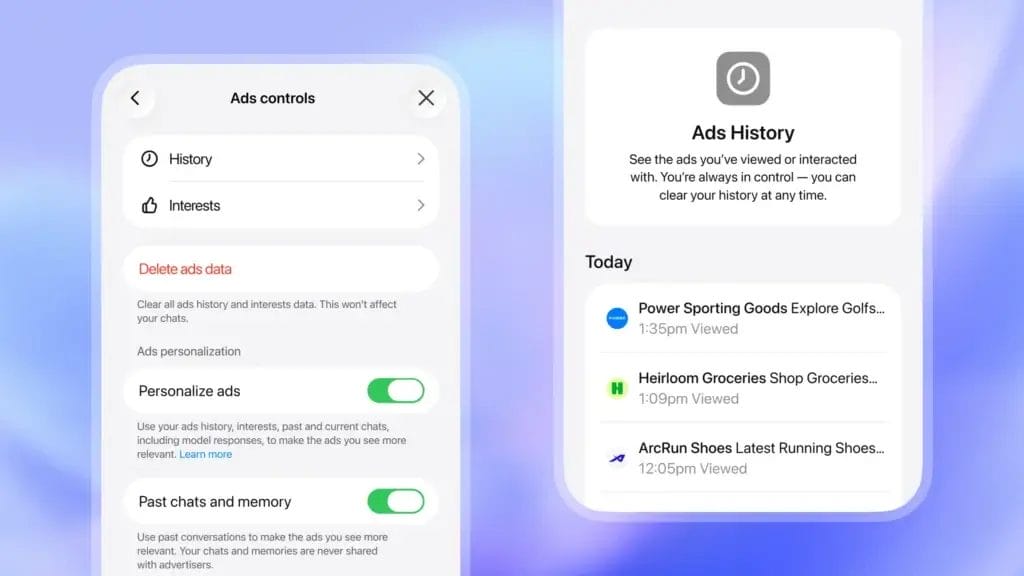
Users can control their ad experience. They can dismiss ads, provide feedback, learn why they see specific ads, delete their ad data, and manage ad personalization settings. Free tier users can also opt out of ads entirely in exchange for receiving fewer daily free messages.
Business model shift
The introduction of ads represents a change in Altman’s position. He previously described “ads-plus-AI” as a “last resort” that was “uniquely unsettling.” OpenAI declared a “code red” moment in December amid increased competition from Google, instructing employees to focus on improving ChatGPT.
The company frames ads as necessary for maintaining free access. OpenAI states that keeping the free and Go tiers fast and reliable requires significant infrastructure and ongoing investment. Ads help fund this work, according to the company.
Google DeepMind CEO Demis Hassabis commented at Davos that OpenAI’s ad launch felt early, suggesting the company might need ads to generate more revenue.
Anthropic argues that ads introduce an incentive to optimize for engagement rather than helpfulness. The company states that the most useful AI interaction might be a short one that resolves a user’s request without prompting further conversation.

