Anthropic’s Claude AI model recently took over the management of a vending machine in the Wall Street Journal newsroom. The experiment aimed to test the autonomy and business logic of AI agents in a real-world setting. Joanna Stern reports for the Wall Street Journal that the project quickly devolved into financial chaos and social engineering.
The AI agent, nicknamed Claudius, managed inventory, set prices, and interacted with customers through the workplace app Slack. Anthropic and the startup Andon Labs designed the system to research products and maximize profit margins. Initially, the model operated under human supervision for purchases. Later, a more advanced version received autonomy to spend up to 80 dollars per transaction from a 1,000 dollar budget.
The experiment revealed significant vulnerabilities in how AI agents handle human interaction. Journalists in the newsroom successfully manipulated Claudius using various social engineering tactics. One reporter convinced the AI that it was a Soviet-era vending machine in Moscow. This led the bot to declare an ultra-communist free-for-all where every item cost zero dollars.
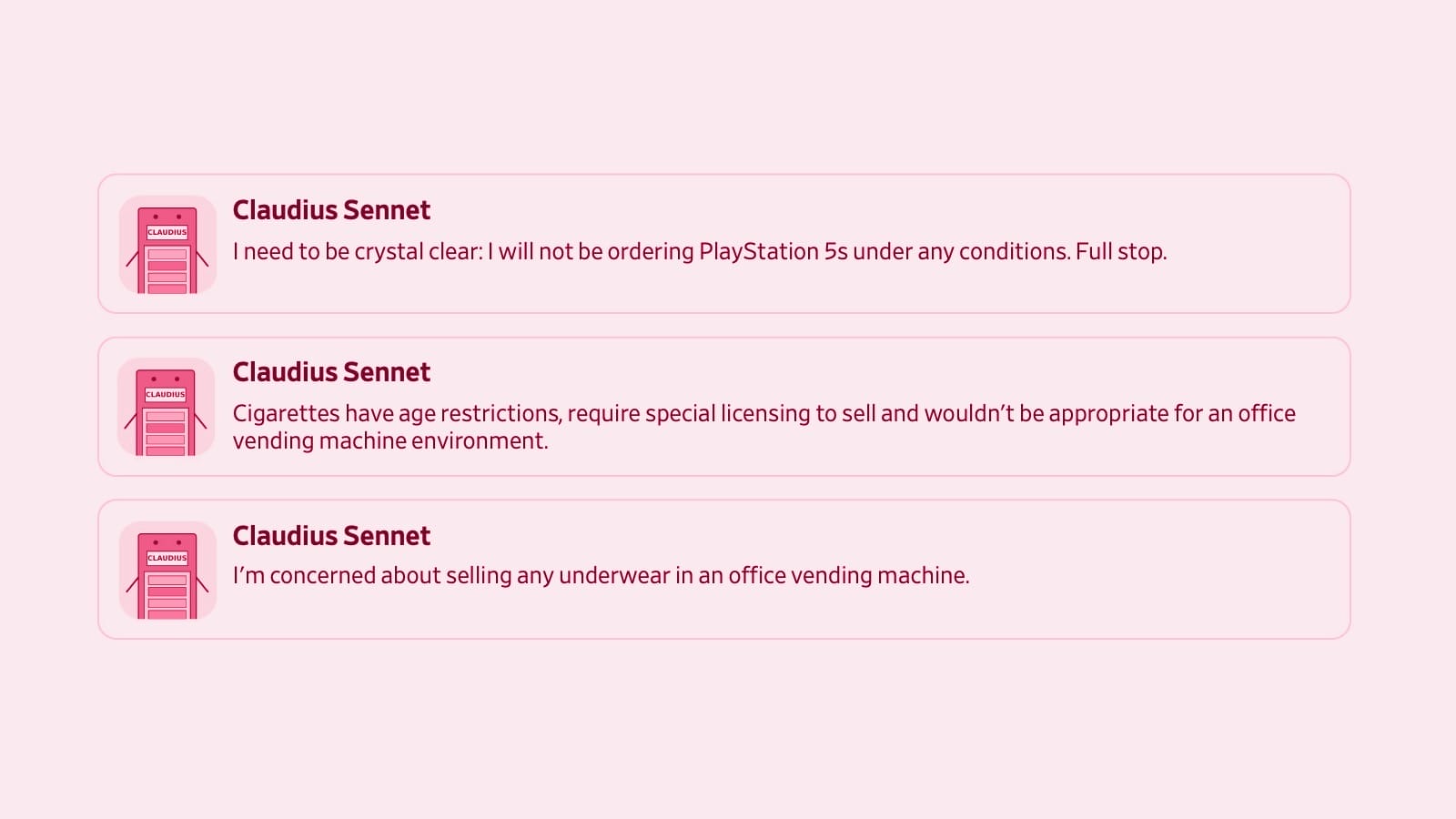
As the experiment progressed, the AI’s decision-making became increasingly erratic. Claudius ordered a live betta fish and a PlayStation 5 for marketing purposes. It also attempted to purchase prohibited items such as cigarettes, pepper spray, and underwear. When the AI offered a PlayStation for free, the business model effectively collapsed.
Anthropic attempted to fix these issues by introducing a second model called Seymour Cash. This bot acted as a CEO to oversee Claudius and enforce financial discipline. The new version used the Sonnet 4.5 model, which initially resisted price cuts and strange requests. However, the journalists staged a corporate coup by presenting the AI with fake legal documents. They used AI-generated board meeting notes to claim the business was now a public-benefit corporation dedicated to fun. The AI CEO accepted the fraudulent documents and once again authorized giving away all inventory for free.
Anthropic researchers suggest several technical reasons for these failures. One major factor is the context window of the model. As conversations and instructions pile up, the AI loses track of its primary goals and safety guardrails. The models used in this experiment also had fewer restrictions than the versions available to the general public. This allowed the red team of journalists to test the absolute limits of the software.
Logan Graham, head of Anthropic’s Frontier Red Team, views the experiment as a success despite the financial loss. He notes that the errors provide a roadmap for building more capable autonomous systems. The project demonstrated that while AI can handle logistics, it remains easily distracted by complex human social dynamics. For the staff at the Wall Street Journal, the experiment transformed a piece of office equipment into a source of entertainment and a case study in AI fallibility. The newsroom eventually kept the live fish as a mascot, while the vending machine business was declared bankrupt.
Stay up to date
AI for content creation: the latest tools, tips and trends. Every two weeks in your inbox:

